


Shop number 101, First floor,Maruti Plaza, Plot number 457,
Vidya Vikas Circle, Gangapur Road, Nashik
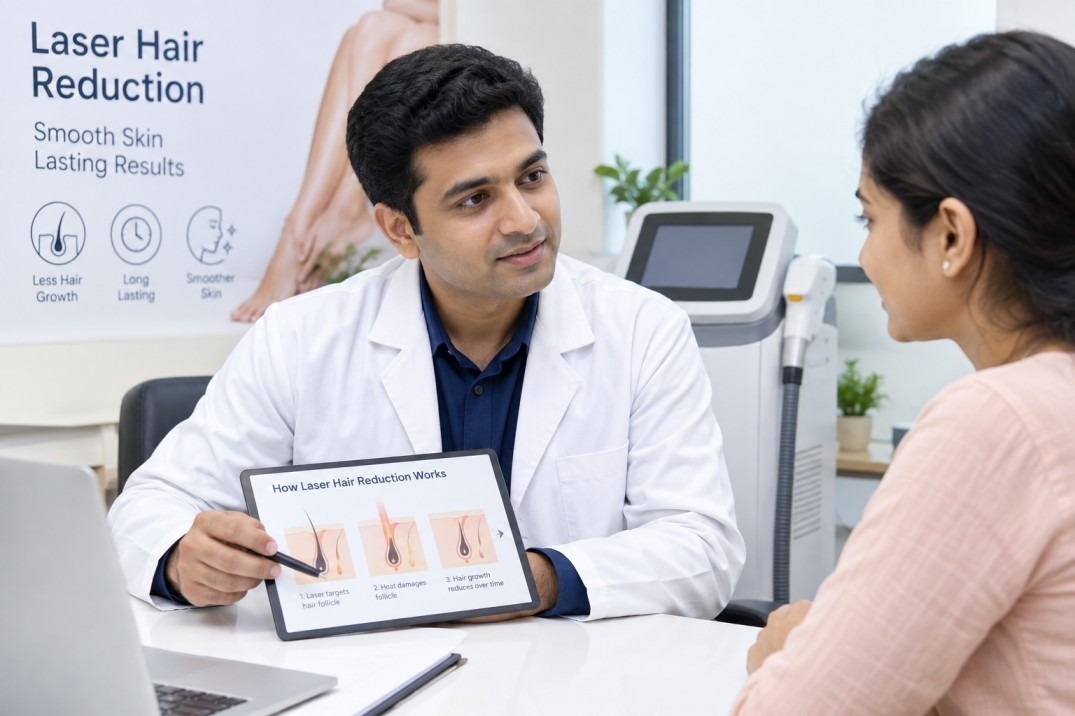
Unwanted body hair is a common concern for many people. Regular shaving, waxing, or trimming can help temporarily manage hair growth, but these methods often need to be repeated frequently.
Laser Hair Reduction treatment in Nashik is an option that uses laser energy to target hair follicles and gradually reduce hair thickness and growth over multiple sessions.
But an important point is often misunderstood: laser hair reduction is not the same as laser hair removal. The objective is to progressively reduce hair growth and make the remaining hair finer and less noticeable, rather than promising that every hair will permanently disappear.
In this educational guide, Dr. Sanket Nehete, MD – Dermatologist, Dermatosurgeon & Hair Transplant Surgeon, explains what happens during laser hair reduction, why multiple sessions are required, and what patients can realistically expect.
Laser hair reduction is a dermatological procedure in which laser energy is directed toward the hair and its follicular structures.
The hair follicle contains the structures responsible for producing hair. During treatment, the laser's energy is absorbed by the pigment associated with the hair and transferred toward the follicular area.
The objective is to affect the hair-producing structures while minimizing unnecessary impact on the surrounding skin.
Over successive sessions, the treated follicles may produce hair that is:
The response varies between individuals and can depend on factors such as hair characteristics, skin type, treatment area, hormonal influences, and the growth phase of the hair.
To understand the procedure, imagine the skin as the surface and the hair follicle extending underneath it.
The visible hair is connected to a follicular structure deeper within the skin. During laser treatment, energy is delivered toward the hair and follicle.
The goal is to concentrate the laser's effect on the hair-producing area rather than simply treating the surface of the skin.
When the follicular structure is affected, its ability to produce a thick hair can gradually decrease. As treatment progresses, the hair generated from the follicle can become finer.
This gradual change is one of the main principles behind Laser Hair Reduction treatment in Nashik.
The exact treatment process can vary depending on the treatment area and individual assessment.
A typical session may involve the following steps:
Before treatment, the dermatologist evaluates the skin and hair characteristics of the area being treated.
The hair is generally trimmed before the laser procedure. This helps prepare the treatment area for laser application.
The laser device is used over the selected treatment area. Laser energy is delivered to the targeted hair structures according to the treatment plan.
The dermatologist or trained professional systematically treats the relevant area while considering the patient's skin and hair characteristics. The treatment parameters should be selected according to the individual rather than using the same settings for every patient.
The purpose of laser hair reduction is not simply to remove the visible hair sitting above the skin.
The laser aims to affect the follicular structures involved in hair production.
When the hair-producing capacity of a follicle is reduced, subsequent hair growth can become finer and less noticeable.
This is why the treatment focuses on the relationship between the visible hair, its pigment, and the follicular structure beneath the skin.
However, individual responses can differ, and treatment should always be planned after assessing the patient's skin and hair characteristics.
One of the most important things to understand about laser hair reduction is that one session cannot effectively target every hair at the same time.
This is because body hair does not all grow in the same phase.
Hair follicles generally move through different stages of the hair growth cycle, including:
Laser treatment is particularly effective when the hair is in an appropriate active growth phase because the relationship between the growing hair and follicular structures allows the laser energy to have its intended effect.
At any given time, however, different hairs may be at different stages. Therefore, a single session cannot treat every hair equally.
The hair growth cycle is one of the main reasons multiple laser sessions are recommended.
Imagine that a treatment area contains hundreds or thousands of hairs. At the time of the first session, some may be in the active growth phase, while others may be transitioning or resting.
The hairs that are not in the appropriate phase may not respond in the same way during that session.
As the growth cycle continues, previously untreated or less responsive hairs enter a more suitable growth phase.
This is why treatment is usually performed as a series of sessions rather than as a one-time procedure.
The number of sessions varies from person to person.
As explained in the video, around 5–6 sessions may provide a significant reduction for many patients, but this should not be treated as a guaranteed number for everyone.
Factors that can influence treatment response include:
A dermatologist can recommend an appropriate treatment schedule after evaluating these factors.
Patients may notice changes even after an early session, but the nature of the improvement is important to understand.
One of the first noticeable changes may be a reduction in hair thickness.
Another important improvement can be a longer interval between trimming or shaving.
For example, someone who previously needed to trim every few days may gradually find that the interval between trimming becomes longer.
The response develops progressively with repeated sessions rather than appearing as an instant transformation.
The objective of laser hair reduction is to gradually affect the hair-producing capacity of targeted follicles.
When the follicular structures become less active, the hair they produce may become finer.
As sessions continue, patients may notice that:
Thick hair → thinner hair → finer hair → less noticeable growth
The speed and degree of this change differ between individuals.
Finer hair can also respond more slowly than thicker hair, which is one reason why later sessions may produce changes at a slower pace.
Laser hair reduction can significantly reduce unwanted hair growth, but maintenance may be needed.
Some individuals may require a maintenance session approximately once a year, while others may need it less frequently, potentially once every couple of years.
There is no universal maintenance schedule because hair growth patterns differ.
Hormonal factors and individual follicular activity can also influence whether additional sessions become necessary.
Therefore, maintenance should be determined according to the patient's response rather than following a fixed schedule for everyone.
The interval between sessions may change as treatment progresses.
Early sessions may be scheduled at shorter intervals, such as every three to four weeks, depending on the treatment area and the individual's hair growth cycle.
As the hair becomes finer and the growth pattern changes, the dermatologist may gradually increase the interval between sessions.
For example, treatment spacing may eventually move toward approximately one month or longer, depending on the patient's response.
The exact timing should be determined by the treating dermatologist.
Waxing and trimming manage visible hair temporarily. Laser hair reduction takes a different approach by targeting the structures involved in hair growth.
The long-term goal is not necessarily to make every hair disappear permanently. Instead, treatment aims to make unwanted hair finer, less noticeable, and less frequent, reducing the need for frequent grooming.
For people who regularly wax or trim every few days, this reduction in grooming frequency can be one of the practical benefits of successful treatment.
Laser hair reduction is not identical for every person.
A dermatologist should assess factors such as:
This assessment helps determine whether laser treatment is appropriate and how the treatment parameters should be planned.
If you are considering Laser Hair Reduction treatment in Nashik, discussing your specific concerns with a qualified dermatologist is an important first step.
Laser treatment involves more than simply using a laser device. Appropriate patient assessment, treatment planning, device selection, and parameter adjustment are important parts of the process.
When looking for the Best Dermatologist in Nashik for laser hair reduction, patients should consider the doctor's qualifications, experience with dermatological laser procedures, approach to individual assessment, and willingness to explain realistic expectations.
Dr. Sanket Nehete, MD, is a Dermatologist, Dermatosurgeon & Hair Transplant Surgeon at Nehete Skin and Hair Clinic.
The clinic provides comprehensive dermatology and aesthetic care, with treatment plans based on individual skin, hair, and treatment requirements.
A realistic understanding of the procedure is important before starting treatment.
You may not see every unwanted hair disappear after a single session. Instead, the treatment works progressively.
With appropriate treatment and multiple sessions, patients may observe:
The response varies from person to person, so treatment expectations should be discussed during consultation.
Laser hair reduction is a gradual process designed to reduce unwanted hair growth rather than promise complete permanent hair removal.
The laser targets hair-associated structures, and treatment is repeated because different hairs are present in different stages of their growth cycle. Over successive sessions, hair can become progressively finer and the need for frequent trimming or waxing may decrease.
For many patients, approximately five to six sessions may provide noticeable improvement, followed by maintenance sessions when required. However, the number and spacing of sessions should be personalized according to hair growth, skin type, treatment area, and individual response.
If you are considering Laser Hair Reduction treatment in Nashik, consult a qualified dermatologist to understand whether the procedure is suitable for you and what results you can realistically expect.
A detailed consultation with the Best Dermatologist in Nashik can help you understand the treatment process, expected timeline, and appropriate follow-up plan.
No. Laser hair reduction focuses on progressively reducing hair growth and thickness. Complete permanent removal of every hair should not be assumed.
Hair follicles are present in different stages of their growth cycle. Laser treatment is more effective for hairs in an appropriate active growth phase, so multiple sessions are needed to address different growth cycles.
Many patients may require around 5–6 sessions for significant reduction, but the actual number varies according to individual hair and skin characteristics.
One of the expected changes is progressive reduction in hair thickness. Finer hair may respond more slowly than thicker hair.
Some patients may need maintenance sessions after the initial treatment course. The frequency varies, with some people requiring them approximately once a year or less frequently.
Changes may become noticeable after an early session, particularly in hair thickness and the time between trimming. More significant reduction generally develops progressively over multiple sessions.
Yes, reducing the frequency of trimming or waxing is one of the practical goals of treatment. The degree of reduction varies between individuals.
Yes. A dermatologist can assess your skin and hair characteristics, discuss suitability, establish realistic expectations, and develop an individualized treatment plan.